Lakers: production-grade EDHOC for the IoT, in Rust
Sep 30, 2024
·
2 min read
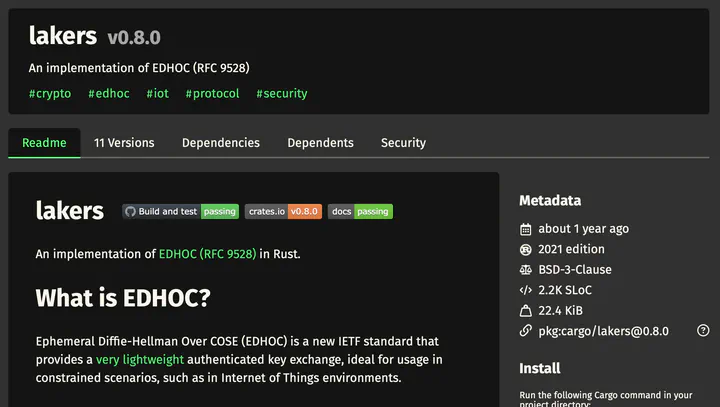 Lakers — Rust implementation of EDHOC for constrained IoT devices.
What it is
Lakers is a Rust implementation of EDHOC (RFC 9528) — a compact authenticated key-exchange protocol designed for constrained IoT devices. Lakers runs both on full systems (Linux/macOS) and on baremetal microcontrollers (Nordic nRF52/nRF53), with bindings in C (lakers-c) and Python (lakers-python). It also implements ELA, the IETF draft I co-author for zero-touch IoT enrollment.
What I built
I have driven Lakers as primary maintainer from April 2023 to October 2024, contributing the bulk of the design, code, and releases:
- Refactor Core EDHOC engine — flexibilize message processing and parsing, add EAD support and error handling, keep it
no_stdcompatible - C FFI (
lakers-c) for embedding in C/C++ projects, with auto-generated headers via cbindgen - Python bindings (
lakers-python) via PyO3 + maturin, multiplatform CI/CD publishing wheels to PyPI - Reference implementation of ELA — used to demo zero-touch IoT enrollment at IETF 119 (Brisbane)
- Crypto agility — maintaining pluggable backends: pure-Rust, ARM PSA, Nordic CryptoCell
- Formal verification with Hax / F* (collaboration with Inria Prosecco and Cryspen) - proving panic-freedom and parser robustness
- Integration adoption — used by aiocoap (the canonical Python CoAP library) and RIOT-rs (CoAP+EDHOC+OSCORE on embedded Rust)
Why it’s hard
EDHOC is a concise protocol on paper but a hard one to ship well:
- It must fit into a few kB of RAM on a microcontroller while staying robust against parser bugs
- It must compile to both
std(servers, tests) andno_stdbaremetal targets - It must be callable from C and Python without leaking a memory-safety mess across the FFI boundary
- The Rust embedded crypto ecosystem is fragmented — different backends, different APIs, different platforms
- Formal verification of the parser was a multi-month collaboration with type-theory experts to make the Rust code amenable to F* proofs
Numbers
- 80k+ downloads across crates.io and PyPI
- Used in 5+ academic papers
- 3 language bindings: Rust, C (incl. C++ via Brian Sipos, Johns Hopkins), Python
- 3 crypto backends: pure-Rust, PSA, Nordic CryptoCell
- Production users: aiocoap, RIOT-rs
Publications
- Performance Comparison of EDHOC and DTLS 1.3 in Internet-of-Things Environments. G. Fedrecheski, M. Vučinić, T. Watteyne. IEEE WCNC 2024, Dubai. [Paper] — used Lakers to show ×6–14 smaller packets, ×1.4 faster handshakes, ×2.8 less energy than DTLS 1.3.
Links
- Lakers on GitHub — source
- Lakers on crates.io — Rust package
- lakers-python on PyPI — Python wheel
- EDHOC RFC 9528 — the protocol Lakers implements